If you’ve ever driven a vehicle with a manual transmission and felt that strange, pulsing vibration when you engage the clutch—or used a machine with a brake disc that makes a juddering, uneven noise as it stops—you’ve experienced friction disc shudder. As a supplier of friction discs for more than 12 years, I’ve fielded this question hundreds of times from mechanics, equipment operators, and fleet managers: what actually causes that annoying, often damaging shudder? It’s not just a “bad part” issue, and it’s rarely a single cause. Let’s break down the science behind it, and what that means for how you source your friction components. Friction Disc
First, let’s define friction disc shudder clearly, because it’s easy to mix it up with other clutch or brake vibrations. Shudder is a low-frequency (usually 5 to 20 Hz, about 300 to 1200 cycles per minute) oscillation that happens right at the moment two friction surfaces make contact and begin transferring torque. Unlike high-frequency brake squeal (which is a different noise, often above 1 kHz), or a misaligned part that causes a steady shake at higher speeds, shudder happens specifically during engagement. For a manual transmission, that’s when you let the clutch pedal out. For a wet clutch in a construction tractor or a power tool, that’s when the system engages to do work. If it happens, it means the friction disc isn’t mating evenly with the mating surface (a flywheel, pressure plate, or brake drum) during torque transfer, and the uneven grip causes that pulsing shake.
Now, the core causes fall into two main categories: issues with the friction disc itself, and issues with the mating components it works against. Let’s start with the disc, because that’s what most people point to first—and where, as a supplier, we can most often help.
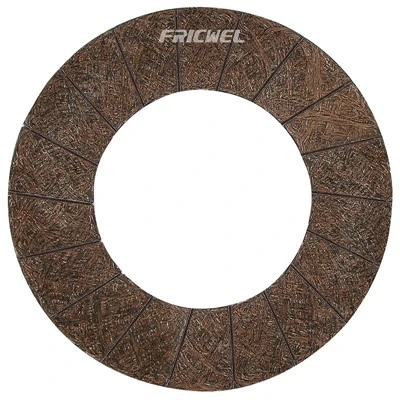
First, friction material degradation and contamination. Friction discs are made of a composite material: usually a mix of Kevlar, carbon fibers, ceramic particles, and binding resins, all pressed onto a steel core. Over time, or with improper use, this material can develop glazing. Glazing is a thin, glass-like layer of overheated resin that forms on the friction surface. It happens when the clutch slips excessively—like when a driver rides the clutch in stop-and-go traffic, or an operator uses a clutch to hold a load instead of engaging fully. That glaze is slippery, so when the disc meets the mating surface, the glaze can’t grip evenly. You get a cycle: the disc grips a little, then slips a little, then grips again, repeating fast enough to make that shudder. We see this a lot with fleet delivery vehicles, which do a lot of city stop-and-go driving—if the driver doesn’t adjust their technique, the clutch glaze forms in just 20,000 miles, leading to consistent shudder.
Contamination is another big one on the friction disc. Oil, grease, brake fluid, or even dust from the environment can get onto the friction surface. For dry discs (used in passenger cars), this is often from a leaking rear main seal or a worn transmission input shaft seal. For wet discs (used in heavy equipment, where the clutch is bathed in oil), this can come from metal shavings from other engine parts, or degraded hydraulic fluid. When a small amount of oil gets on the disc, it creates a boundary layer between the two surfaces. That layer prevents uniform contact, so instead of the whole disc making smooth contact, tiny patches grip and slip in rotation, causing shudder. We had a customer last year with a 50-ton excavator that had constant shudder for months—turns out a seal on the hydraulic pump was leaking, and oil was seeping onto the friction disc. Replacing that seal and resurfacing the mating plate fixed the issue.
Another disc-specific cause: warping or uneven thickness. The steel core of the friction disc has to be perfectly flat and uniform to seat against the mating surface. If the disc is too thin in some spots, or warped from overheating (another side effect of riding the clutch), when the pressure plate presses it against the flywheel, only parts of the disc make contact. That uneven pressure creates uneven torque transfer, which causes oscillation. We measure disc flatness to within 0.05 millimeters in our factory—if a disc warps more than that, it’s not just a quality issue, it’s a direct cause of shudder. A lot of low-quality discs from overseas suppliers skip this step, so they’re more prone to warping under normal operating stress.
Now, the other side: mating component issues, which are often mistaken for a bad friction disc. Let’s be clear—if the problem is the flywheel (for clutches) or the brake drum (for brakes), even a perfect friction disc will shudder. Why? Mating surface finish is critical. The surface that the disc presses against has to have a specific texture: not too smooth, not too rough. If it’s too smooth (like a resurfaced flywheel that’s polished too much), it can’t grip the friction material evenly, leading to slip and shudder. If it’s too rough, the tiny ridges on the surface can catch and release the disc unevenly. We recommend a surface roughness of 1.6 to 3.2 micrometers for most dry friction discs—any outside that range causes problems. That’s why, when someone brings us a disc that’s shuddering, we always check the mating surface first before blaming the disc.
Mating surface distortion is another big one. Over time, a flywheel can develop hot spots—small, localized areas that get much hotter than the rest during clutch engagement. These hot spots cause the flywheel to warp, so it’s not flat anymore. That means the pressure plate, which applies force to the disc, can’t make uniform contact. Same with brake drums: repeated braking can cause the drum to oval, or develop runout (wobble) as it rotates. Even a tiny amount of runout (0.1 mm or more) on the mating surface will cause the friction disc to engage unevenly, leading to shudder. Last quarter, we had a customer with a fleet of pickup trucks that were replacing friction discs every 15,000 miles due to shudder. We sent a technician to check their flywheels, and they found that the flywheels were warped after only one resurface—because the shop was resurfacing them too thin, which made them prone to warping under heat. Replacing the flywheels and using our high-flatness discs fixed the issue long-term.
Another underdiscussed cause: axial play in the drivetrain. This is movement along the axis of the friction disc, not rotational. For example, a worn transmission input shaft bearing or a worn pilot bearing can let the input shaft move back and forth a little. When the clutch engages, that movement means the disc isn’t seated firmly against the mating surface—it’s bouncing slightly, causing uneven engagement and shudder. We once worked with a manufacturer of woodworking machinery that had constant shudder on their saw blades’ clutch. They kept changing friction discs, but the problem was a worn bearing in the motor shaft, which caused axial play. Replacing that bearing fixed the issue, no disc changes needed. And for wet clutches, hydraulic issues can cause this too: low hydraulic pressure means the pressure plate doesn’t apply consistent force to the disc, leading to slip and oscillation.
Wait, there’s also a dynamic friction coefficient mismatch. Friction isn’t a constant number—static friction (the force needed to start two surfaces moving) is always higher than kinetic friction (the force needed to keep them moving). A good friction disc has a consistent friction coefficient across the entire surface, and a stable difference between static and kinetic. If the friction material has inconsistent hardness (some patches are harder, some softer), the friction coefficient varies, so when the disc engages, some parts grip more, some less, causing that oscillation. That’s why we test every batch of our discs for friction coefficient uniformity—we test 10 random samples per batch, and if the variation is more than 0.05, we reject the batch. A lot of suppliers don’t do this testing, so their discs have uneven friction, leading to shudder.
Now, why does this matter for you? Shudder isn’t just annoying—it’s damaging. It causes excessive wear on the friction disc, the mating surfaces, and the drivetrain components. If you ignore it, you’ll be replacing parts way more often than you need to, which adds up in downtime and replacement costs. As a friction disc supplier, our job isn’t just to sell you a disc—it’s to help you diagnose the root cause, so you’re not wasting money on parts that won’t fix the problem.
A lot of people ask us: “Should I replace the friction disc, or the mating surface?” The answer is: if the mating surface is smooth, flat, and has a good finish, then the disc is the issue. If the mating surface is warped, has deep scratches, or excessive runout, then you need to fix that first. We can also help you choose the right friction material for your application—for example, heavy equipment operating in wet, dusty conditions needs a different material than a passenger car with stop-and-go city driving. Using the wrong material can lead to faster glaze formation, contamination, and shudder.
Let’s wrap this up with a quick troubleshooting guide, based on what we see every day: first, check if the shudder happens only at engagement, or also at higher speeds. If it’s at higher speeds, that’s a balance issue, not shudder. If it’s only at engagement, inspect the mating surface for flatness and finish. Check for oil or fluid leaks that might be contaminating the disc. Measure axial play in the drivetrain. If all those are good, then the issue is likely the friction disc itself—look for glazing, uneven wear, or warping. And if you’re unsure, send us a sample or describe your application, and we’ll help you troubleshoot.

If you’re dealing with friction disc shudder, or you’re looking for a consistent, high-quality friction disc supplier that stands behind their products, we’re here to help. Our team has worked with mechanics, fleet managers, and equipment manufacturers to resolve shudder issues for over a decade, and we can provide samples, technical support, and tailored solutions for your specific needs. Reach out to our team to discuss your application and find the right friction disc for you.
Aerospace Sintered Buttons References
- Naunheimer, H., et al. (2011). Automotive Transmissions: Fundamentals, Selection, Design and Application. Springer.
- Holmberg, K., & Erdemir, A. (2017). Global Estimates of Energy Losses Due to Friction in Passenger Cars. Tribology International, 109, 601-610.
- Oberg, E., et al. (2020). Machinery’s Handbook (31st ed.). Industrial Press.
- Ismail, O., et al. (2019). Analysis of Clutch Shudder in Wet Clutches. Proceedings of the Institution of Mechanical Engineers, Part D: Journal of Automobile Engineering, 233(12), 1987-2000.
- SAE International. (2018). Test Procedure for Determining Friction Characteristics of Friction Materials for Automotive Clutches (SAE J661).
Fricwel Automotive Limited
Fricwel Automotive Limited is one of the most experienced friction disc manufacturers and suppliers in China, also supports customized service with low price. We warmly welcome you to buy advanced friction disc made in China here from our factory. Also, free sample is available.
Address: No. 819 Shixin Zhong Rd, Xiaoshan, Hangzhou 311203, China.
E-mail: sales@fricwelauto.com
WebSite: https://www.fricwelfriction.com/
