When dealing with liquid level control in industrial settings, one common challenge is handling foam on the liquid surface. Foam can cause inaccurate level readings and disrupt the normal operation of various processes. As a supplier of RF Admittance Switches, I have witnessed firsthand how these devices can effectively tackle the issue of foam. In this blog, I will explore how an RF Admittance Switch works and how it manages foam on the liquid surface. RF Admittance Switch

Understanding RF Admittance Technology
Before delving into how an RF Admittance Switch handles foam, it’s essential to understand the basic principle behind this technology. RF Admittance is a measurement technique that combines both capacitance and conductance measurements. The switch consists of a sensing probe that is inserted into the liquid or other media. An RF (radio – frequency) signal is applied to the probe, and the admittance between the probe and a reference point (usually the vessel wall) is measured.
Admittance is the reciprocal of impedance and is a complex quantity that includes both the real part (conductance) and the imaginary part (capacitance). The RF Admittance Switch analyzes the changes in admittance to detect the presence of liquid or a change in the media around the probe.
Challenges Posed by Foam in Liquid Level Measurement
Foam on the liquid surface can be a significant problem for traditional level measurement devices. Foam has a different dielectric constant compared to the liquid itself. Dielectric constant is a measure of how well a material can store electrical energy in an electric field. Since foam is mostly air with small liquid bubbles, its dielectric constant is much lower than that of the pure liquid.
Capacitance – based level sensors, for example, rely on changes in capacitance caused by the presence of liquid around the probe. If foam covers the probe, the capacitance reading will be affected because the foam has a different dielectric constant. This can lead to false level readings, either indicating a higher or lower level than the actual liquid level. Additionally, foam can be very dynamic, constantly changing in density and thickness, which further complicates the measurement process.
How an RF Admittance Switch Overcomes Foam Issues
1. Dual – parameter Measurement
One of the key advantages of an RF Admittance Switch is its ability to measure both capacitance and conductance. Foam typically has a low conductivity, while the liquid usually has a higher conductivity. By measuring both the capacitance and the conductance, the RF Admittance Switch can distinguish between the liquid and the foam.
When the probe is in contact with foam, the capacitance may change due to the foam’s dielectric properties. However, the low conductivity of the foam will result in a different conductance reading compared to when the probe is in the liquid. The switch’s electronics are designed to analyze these two parameters simultaneously and use a specific algorithm to determine whether the probe is in contact with liquid or foam.
For example, let’s assume that we are measuring the level of a liquid in a chemical tank. The liquid has a relatively high conductivity due to the presence of dissolved ions. The foam on the surface, on the other hand, is mostly air and has a very low conductivity. The RF Admittance Switch can detect the low – conductivity foam and ignore it when determining the actual liquid level.
2. Frequency Selection
RF Admittance Switches operate at specific radio frequencies. The choice of frequency is crucial in dealing with foam. Different frequencies interact differently with the media around the probe. Higher frequencies can be more sensitive to the dielectric properties of the media, while lower frequencies can be more affected by the conductivity.
By carefully selecting the operating frequency, the RF Admittance Switch can optimize its performance in the presence of foam. For instance, in applications where the foam has a mainly dielectric effect (i.e., it affects the capacitance more than the conductivity), a higher operating frequency may be selected to enhance the sensitivity to the liquid – foam difference. Conversely, if the conductivity difference between the liquid and the foam is more significant, a lower frequency might be more appropriate.
3. Advanced Signal Processing
Modern RF Admittance Switches are equipped with advanced signal – processing algorithms. These algorithms can filter out the noise and interference caused by the foam. Foam is often in a state of constant motion, with bubbles bursting and reforming, which can lead to rapid and erratic changes in the measured admittance.
The signal – processing algorithms can analyze the pattern of these changes and distinguish them from the stable admittance changes that occur when the liquid level actually changes. For example, the algorithm can set a threshold for the rate of change of admittance. If the rate of change is too high, it may be an indication of foam movement rather than a true liquid – level change. The switch can then ignore these rapid changes and focus on the more stable admittance values associated with the liquid.
Real – World Applications
RF Admittance Switches are widely used in various industries where foam is a common problem. One such industry is the food and beverage industry. In beer brewing, for example, the fermentation process can produce a significant amount of foam on the surface of the liquid. Accurate level measurement is crucial for proper batch control and ensuring the quality of the final product. An RF Admittance Switch can be installed in the fermentation tank to detect the actual liquid level, ignoring the foam and providing reliable level information.
Another application is in the wastewater treatment industry. During the treatment process, aeration can cause the formation of foam on the surface of the wastewater. The RF Admittance Switch can be used to monitor the liquid level in treatment tanks, ensuring that the level does not exceed the allowed limit and preventing overflow or improper treatment.
Conclusion
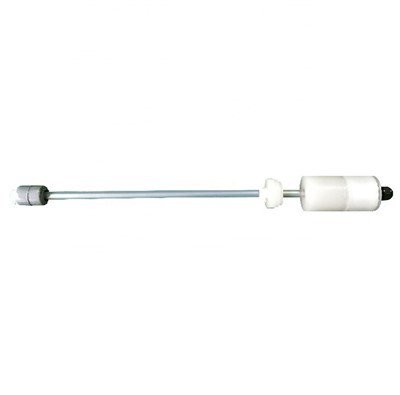
In conclusion, an RF Admittance Switch is a highly effective solution for handling foam on the liquid surface in industrial level – measurement applications. Through dual – parameter measurement, frequency selection, and advanced signal processing, these switches can accurately distinguish between liquid and foam, providing reliable level information even in the most challenging environments.
Radar Level Meter If you are facing problems with foam in your liquid – level measurement applications, our RF Admittance Switches are designed to meet your needs. We offer a wide range of products with different probe configurations, operating frequencies, and signal – processing capabilities to ensure optimal performance in your specific application. Contact us to discuss your requirements and explore how our RF Admittance Switches can help you solve your foam – related level – measurement problems.
References
- P. J. Enjeti, "Industrial Instrumentation and Control," Prentice Hall, 2008.
- C. D. Johnson, "Capacitance and RF Admittance Level Sensors: Principles and Applications," Instrumentation Technology, 2012.
- C. A. Hall, "Level Measurement Technologies in the Process Industries," Elsevier, 2016.
Shandong Aipuxin Automation Instrument Co., Ltd.
Shandong Aipuxin Automation Instrument Co., Ltd. is one of the most professional rf admittance switch manufacturers and suppliers in China, specialized in providing high quality customized service. We warmly welcome you to wholesale cheap rf admittance switch in stock here from our factory. For price consultation, contact us.
Address: Huigu Phase 1, Zhongnan High-tech Canal New City, Rencheng District, Jining City, Shandong Province
E-mail: aipuxin0124@gmail.com
WebSite: https://www.aipxin.com/
